Why touching your toes matters
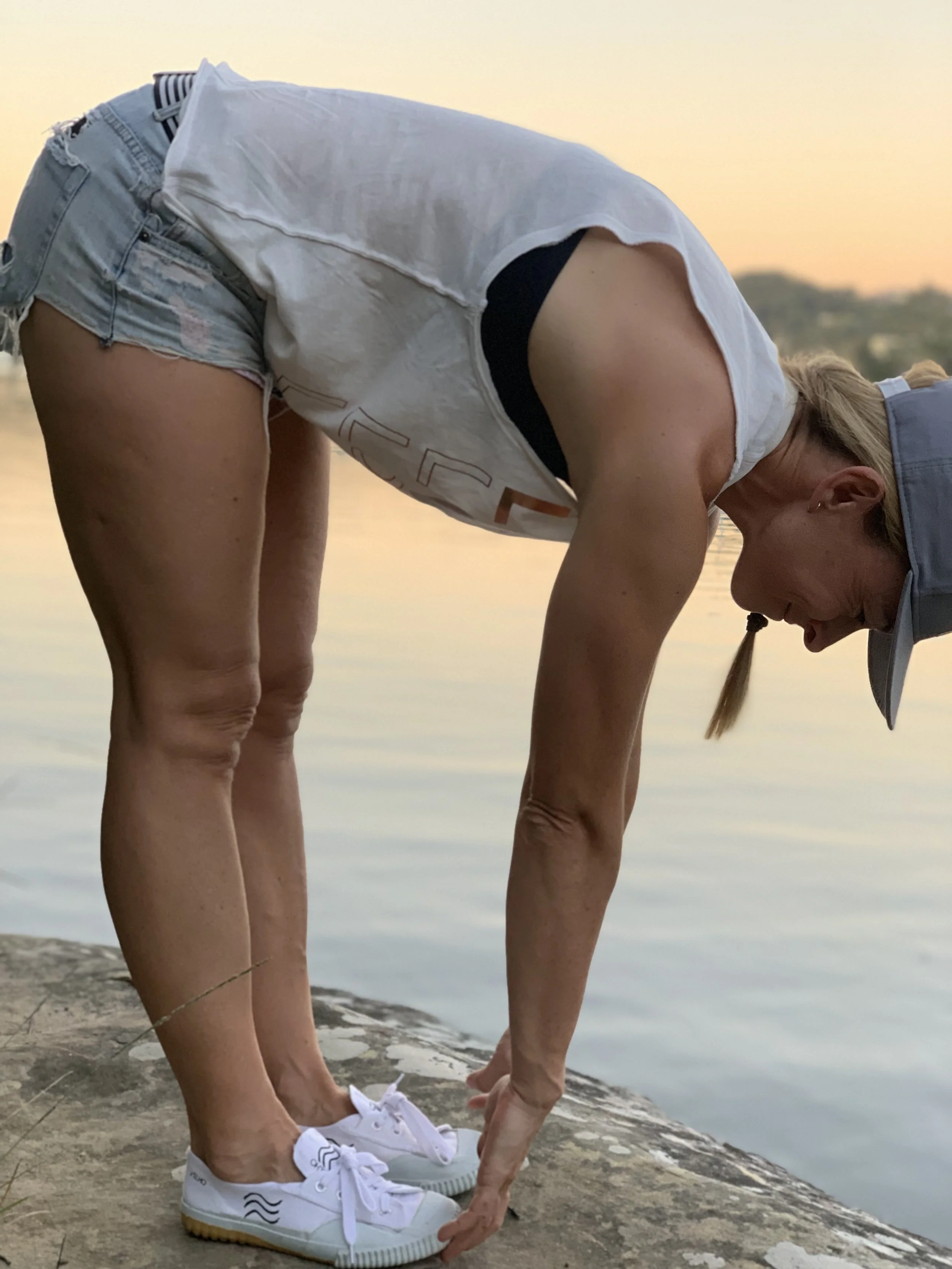
Your brain is pretty much on autopilot with great pr: it doesn’t ask what you want; it just repeats what feels safe and strengthens what happens often. Touching your toes matters cos its telling you just what the rest of your body is doing while do!
Being able to touch your toes matters cos it tells you how flexible you are, how tight your hamstrings are, or what’s inferring with your sciatic nerve, right? Or the length of your biggest artery so a great longevity checkin? Yes, but sooooo much more!
Personally I think being able to touch your toes is a given and losing it should make you realise you’ve got work to do! Which immediately brings eye rolls cos it sounds like a lot of time investment, longevity being a long way off for most of us, right? But the toe touch is:
an immediate checkin so we can know what to work on (ie our work-it-out!) that day
a real time demo that can show us just how quickly correctives can take effect in the body
and that being able to touch our toes is less about our flexibility or hamstrings or an indicator of heart health but a sign of how multiple areas of your body - hips, spine, and nerves - are interacting and affecting your overall movement and flexibility. It's a question of full-body control, balance, and strength rather than a simple muscle stretch.
Another of my mentors, Gray Cook, demonstrates the effects of the toe touch when he says ‘it’s a classic example of focusing on parts instead of patterns, hardware instead of software.’ Love that: the reason many people can’t touch their toes has nothing to do with the flexibility of their hamstring and everything to do with the sequence of their movement toward the ground; they’re more dependent on their legs for stabilisation than their core.
So what to do:
Stand on a board so your toes are up and heels down. One of the most common reasons that you can’t touch their toes is an insufficient posterior weight shift. If you’re unable to shift your posterior weight backward as the upper body half of your body leans down and forward, your hamstrings will contract to prevent you from losing balance and falling forward. In this case, the hamstrings are merely acting as parking brakes to stop you from hurting yourself. Standing on the board so that your heels are down and toes are up forces you into a posterior weight shift. We become less dependent on our legs to hold us up and more dependent on our core and weight shift to keep us balanced.
Squeeze a towel or foam roller between your knees. Keep your feet together, but move your knees apart. Place a roller or towel between your knees. You'll have to bend your knees slightly. Reach for the ground as far as you can. At first sign of tension, squeeze the towel/roller as hard as you can with your knees. This activates your core because anything that makes your adductors fire make your abs fire. When we fire the adductors and abs, we get reciprocal inhibition of extensors of the hip and extensors of the back. When they relax, you'll stop fighting the movement. Squeezing the knees basically overrides your protective mechanism.
Bend your knees so that you touch the floor each time. Break the pattern.
Breathe on the way down. As Gray Cook says, "Breathing should not be disconnected from movement. Breathe first, then let the movement unfold."
Stand on the board so that the toes are down and heels are up. Repeat above.
The focus isn't on the end result of touching your toes, but on the journey and the body mechanics involved. It's about understanding the story your body is telling you through its movements and limitations. Give your body the pr it needs to feel safe!